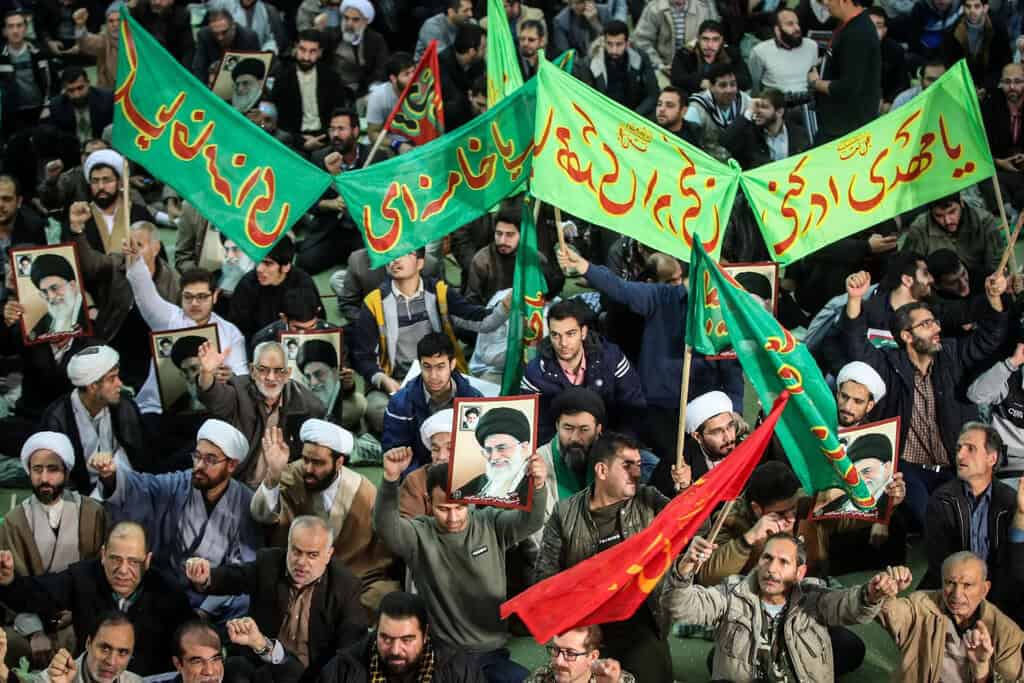
BEIRUT (IO) — The strategic landscape of the Middle East, already volatile, has been further reshaped by recent, deadly exchanges of strikes between Iran and Israel. Against this backdrop, a long-standing question continues to resonate in Western capitals: Is the dream of fundamental regime change in Tehran merely a free-world pipedream, a fervent hope unlikely to be achieved, or an increasingly imminent reality? As the Islamic Republic grapples with direct military confrontation and the perceived fracturing of its regional “Axis of Resistance,” the complex calculus of its stability is shifting.
For decades, many in the west have eyed Tehran’s clerical establishment with a mix of frustration and an earnest desire for its transformation into a more open, democratic society. Yet, the regime, created in the fires of the 1979 Islamic Revolution, has repeatedly proven its capacity for survival, enduring internal unrest, crippling sanctions, and relentless external pressure. The recent escalation of direct hostilities with Israel, culminating in tit-for-tat strikes across each other’s territories, marks a dangerous new chapter, directly testing the regime’s core deterrence strategy and its ability to withstand external shocks.
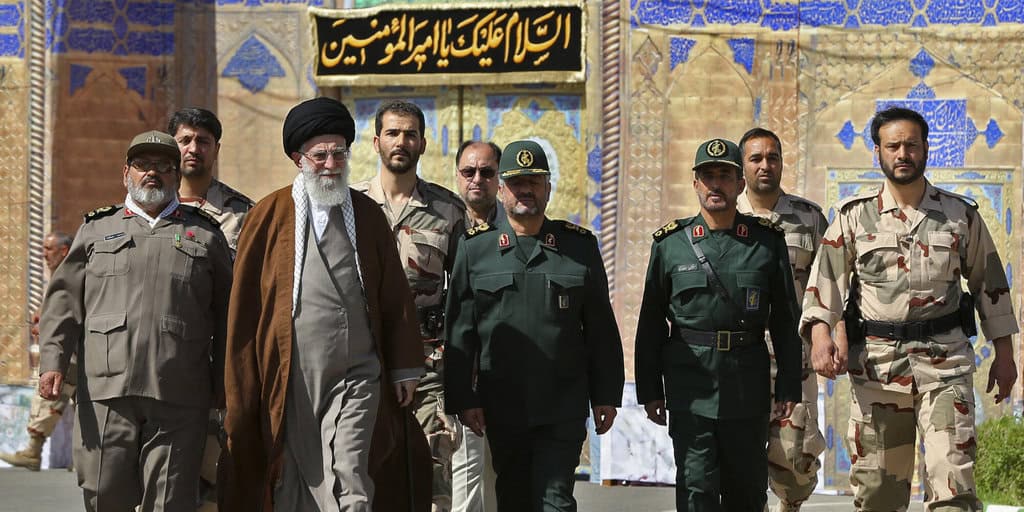
Those who contend that regime change remains a distant dream point to the formidable power of the Islamic Revolutionary Guard Corps (IRGC) and its pervasive intelligence network. The regime’s internal security apparatus is incredibly resilient and deeply embedded in all aspects of society. They have demonstrated a chilling effectiveness in suppressing dissent, atomizing opposition movements, and maintaining control through a sophisticated blend of military force, ideological indoctrination, and surveillance. This makes internal overthrow exceptionally difficult.
Furthermore, the Iranian opposition, both within the country and scattered across the diaspora, remains fragmented. Historical divisions, diverse political aspirations, and a lack of a universally recognized leadership figure continue to hinder their ability to coalesce into a cohesive challenge. The specter of past foreign interventions looms large, often allowing the regime to effectively frame domestic dissent as foreign-backed subversion, thereby rallying nationalist sentiment and undermining the perceived legitimacy of external hopes for change.
Economically, despite the most severe U.S. and international sanctions in history, Iran has shown an uncanny ability to adapt. While these sanctions have undoubtedly inflicted immense hardship on ordinary citizens, sparking protests over inflation and high unemployment, the government has found alternative revenue streams and deepened strategic alliances with non-Western powers, particularly China and Russia. This adaptive capacity has provided crucial lifelines, preventing a total economic collapse that some Western policymakers had hoped would trigger internal unrest.
While the Iranian economy is undoubtedly strained, it has developed sophisticated mechanisms for sanctions circumvention and relies heavily on informal sectors. The recent Israeli strikes on energy infrastructure could exacerbate economic pain, but the regime has repeatedly proven its willingness to prioritize its survival over the immediate economic well-being of its population.
However, the argument for “imminent reality” is bolstered by intensifying internal pressures and significant external developments that challenge the regime’s long-term stability. The widespread “Woman, Life, Freedom” protests of 2022-2023, though brutally suppressed, laid bare a profound wellspring of public discontent, particularly among youth and women, demanding greater freedoms and economic justice. These grievances remain unresolved, leading to sporadic demonstrations and widespread online activism, suggesting a populace on a knife-edge that could erupt again.
Compounding these internal dynamics is the undeniable shift in regional power projection. Iran’s carefully constructed “Axis of Resistance”—a network of allied militias including Lebanon’s Hezbollah, Iraq’s Popular Mobilization Forces, Yemen’s Houthis, and previously Palestinian factions like Hamas—appears to be under unprecedented strain. The fall of the Assad regime in Syria in late 2024 severed a crucial land bridge for Iranian arms and influence, forcing a strategic recalculation. Recent reports indicate that Hezbollah, facing severe internal Lebanese pressure and Israeli military actions following the tit-for-tat strikes, has significantly curtailed its forward deployment in southern Lebanon. While still potent, the network is arguably less cohesive and less able to project unified power than in previous years, a direct consequence of sustained regional conflicts and targeted operations.
“The Axis of Resistance has absorbed significant blows over the past year and a half, from Gaza to Syria and southern Lebanon,” states a senior middle eastern diplomatic source, speaking on condition of anonymity. “While still a threat, its operational cohesion and ability to project a unified front have been seriously degraded. This lessens Iran’s external deterrence and could expose internal vulnerabilities, impacting the very foundations of the regime’s power projection.”
The advanced age and declining health of Supreme Leader Ayatollah Ali Khamenei, 86, also casts a long shadow over the regime’s future. His eventual succession is a critical juncture, constitutionally entrusted to the Assembly of Experts. While the process is designed for continuity, the intense rivalry among conservative factions vying for power behind the scenes could trigger unpredictable shifts, potentially creating an opening for challenges to the established order. The recent Israeli strikes, which reportedly targeted and killed several high-ranking IRGC commanders and nuclear scientists, further complicate this succession, removing key figures who might have played roles in a smooth transition.
The return of Donald Trump to the U.S. presidency has also introduced a more volatile element to the region. While his administration has voiced support for Israel’s recent actions, Trump’s broader foreign policy has consistently emphasized a transactional approach, potentially leading to unpredictable diplomatic or coercive actions toward Tehran that could either destabilize or inadvertently strengthen the current regime.
Ultimately, the trajectory of the Islamic Republic remains a complex, unpredictable equation. The regime’s historical resilience is undeniable, backed by a formidable security apparatus. Yet, the cumulative pressures of internal discontent, a struggling economy exacerbated by escalating external conflict, and the perceived weakening of its regional proxies, coupled with the inevitable leadership transition, suggest that the status quo is facing its most profound test in decades.
Whether these profound challenges will culminate in the fundamental transformation yearned for by some in the free world remains highly uncertain. But for many observers, the question of regime change in Iran is no longer a distant theoretical exercise; it is an increasingly active and urgent consideration in the volatile geopolitical landscape.